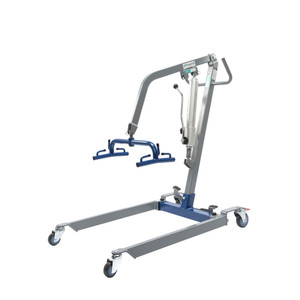
More about Electric Lifts
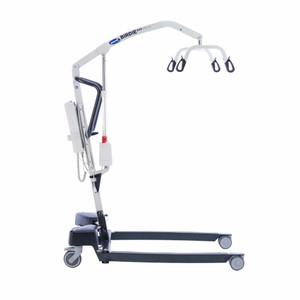
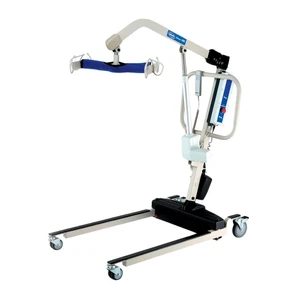
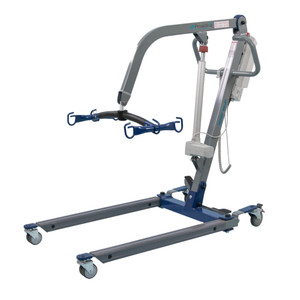
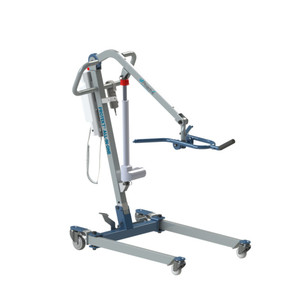
Electric patient lifts use battery-powered operation to raise and lower a person during supported transfers between a bed, wheelchair, commode, or other appropriate surface. Our selection includes models in 450-, 500-, and 600-pound capacity classes, along with designs that offer different base dimensions, storage options, and transfer configurations.
Unlike a hydraulic lift that requires repeated pumping, an electric lift operates through a hand control and powered actuator. This can reduce the physical effort involved in the lifting motion, although the caregiver must still position the lift, attach a compatible sling correctly, guide the user, and follow the manufacturer’s transfer instructions. Explore our broader selection of patient lifts if you are also comparing hydraulic, sit-to-stand, or other lift types.
Benefits of battery-powered patient lifts
A powered lifting mechanism provides smooth, controlled raising and lowering without requiring the caregiver to pump a hydraulic handle. This may be particularly useful in settings where transfers happen several times throughout the day or where manual pumping would be difficult for the caregiver. The hand pendant also allows the caregiver to stay close to the person being transferred while operating the lift.
Electric floor lifts are designed to support full-body transfers when the user cannot complete the movement independently. Depending on the model and sling selected, they can help with transfers involving beds, wheelchairs, commodes, and the floor. Certain lifts may offer powered base adjustment, low base clearance, emergency lowering features, or removable battery packs, but these details vary and should be confirmed for the individual model.
The range also includes standard and heavy-duty frames. A higher weight rating is not simply an extra number on the specification sheet. It may affect the lift’s frame size, overall weight, turning space, sling compatibility, and the amount of room required around furniture. Choosing according to the user, the caregiver, and the transfer environment helps create a more practical setup.
The key decision: electric operation, capacity, base fit, and storage
The first choice is whether battery-powered operation is appropriate compared with a hydraulic lift. Electric patient lifts use a rechargeable battery to power the lifting cycle, while hydraulic models rely on caregiver-operated pumping. Electric operation can make repeated lifting cycles less physically demanding, but it also requires a charging routine and access to a functional battery. Hydraulic lifts do not depend on battery charge, though they require more manual effort during each transfer.
After selecting the operating type, focus on the lift’s weight capacity and physical footprint. The rated capacity must accommodate the user while remaining within all manufacturer limits. The sling must also have the correct size, style, attachment type, and capacity. A lift rated for a particular weight does not make every sling or accessory suitable for that same transfer.
Base width matters because the legs must fit around or beneath the surfaces involved in the transfer. Measure doorways, the space beside the bed, clearance under the bed frame, wheelchair width, and the intended turning area. A lift that fits comfortably in an open room may feel like a shopping cart in a narrow hallway, so measurements should reflect the actual route and furniture layout rather than the room’s total square footage.
Storage is another practical consideration. Some electric lifts fold or separate into manageable sections, while others are intended to remain assembled. If the lift must be stored in a closet, transported between locations, or moved in a vehicle, review folded dimensions and component weights instead of relying on the word “portable.” Customers who expect frequent travel or regular transport can compare our dedicated portable patient lifts.
How to choose
Begin with the transfers that need to be completed, not only the lift’s headline capacity. Consider who will operate the equipment, how often it will be used, where charging will take place, and whether the lift can approach each surface safely. The right measurements can narrow the options quickly and help avoid choosing a model that is difficult to maneuver in the intended space.
It is also important to review the lift and sling as a complete transfer system. Sling style can affect head support, toileting access, positioning, and attachment compatibility. User needs vary, so consult an appropriate healthcare or rehabilitation professional when guidance is needed for transfer technique, positioning, or sling selection.
- Operating mechanism: Decide whether a battery-powered lift or manually pumped hydraulic model is more practical for the caregiver and frequency of transfers.
- Weight rating: Select a lift with a manufacturer-rated capacity appropriate for the user, then verify the capacity of the sling and every related component.
- Base width and opening range: Compare the lift’s closed and open base dimensions with wheelchairs, commodes, beds, doorways, and other transfer surfaces.
- Under-bed clearance: Check the base height against the actual clearance beneath the bed or furniture. Floor trim, caster placement, and bed mechanisms can change usable clearance.
- Lift range: Review the minimum and maximum boom or spreader-bar height for the starting and destination surfaces, especially for low beds or floor transfers.
- Sling compatibility: Confirm the required attachment style, number of connection points, sling size, and support features. Not every sling works with every lift.
- Battery and charging setup: Consider battery runtime, charging location, removable battery options, and whether the model provides a manual or emergency lowering method.
- Maneuvering space: Account for overall length, turning radius, caster size, and the caregiver’s working room around the lift.
- Storage and transport: If the unit will be put away or moved regularly, compare folded dimensions, total weight, and the weight of any removable sections.
- Care environment: Determine whether the lift will be used in a private home, rehabilitation setting, or healthcare facility, and consider how often it will move between rooms.
Aracent Healthcare offers electric lifts from established mobility equipment manufacturers, with options suited to different user capacities and room layouts. If two models look similar on the page, their base measurements, lift range, controls, and storage configuration often reveal which one fits the intended routine more closely.
Frequently asked questions
What is an electric patient lift?
An electric patient lift is a transfer device with a battery-powered actuator that raises and lowers a user in a compatible sling. Most models in this category are mobile floor lifts that roll on casters and use an adjustable base to approach beds, wheelchairs, and other supported transfer surfaces.
The lift provides mechanical support for the raising and lowering portion of a transfer. It does not move or position itself automatically, so a trained caregiver must operate the equipment, guide the user, manage the sling attachments, and follow all instructions supplied with the lift and sling.
How does an electric lift differ from a hydraulic patient lift?
An electric lift raises and lowers the boom through a battery-powered motor controlled by a hand pendant. A hydraulic patient lift uses a pump handle for raising and usually a release control for lowering. Both designs still require careful sling attachment and caregiver guidance.
Battery-powered models can help reduce the repetitive effort of pumping during frequent transfers. Hydraulic lifts avoid dependence on charging and electrical components, but their operation requires more manual input. The appropriate choice depends on transfer frequency, caregiver abilities, maintenance preferences, and the care setting.
What weight capacity should I choose?
Choose a capacity that accommodates the user without exceeding the manufacturer’s rating. This page includes electric lifts across several capacity classes, including standard and heavy-duty options. Do not select by capacity alone, because higher-capacity models may also have wider bases, heavier frames, or different space requirements.
The sling and accessories must be rated appropriately as well. The usable capacity of a transfer setup is limited by its lowest-rated component. Verify the lift, spreader bar, sling, and attachment configuration before use rather than assuming matching brand names guarantee compatibility.
Will an electric patient lift fit under my bed?
Fit depends on the lift’s base height and the available clearance under the bed. Measure from the floor to the lowest obstruction beneath the bed, including frame supports, motor housings, crossbars, and storage items. Adjustable beds may have different clearances depending on their position.
Base width also affects access. Review both the closed and expanded base dimensions, then compare them with the bed frame, wheelchair, commode, and transfer area. If clearance is tight, a few inches can determine whether the lift approaches the surface as intended.
Can an electric patient lift be folded for storage or transportation?
Some models fold, collapse, or separate into components for storage, but this is not standard across every electric lift. A folding frame can be useful where storage space is limited, while a full-size assembled model may be more practical when the lift remains in one room and is used frequently.
Before choosing a folding design, check its folded dimensions and the weight of the heaviest section. A lift may fold compactly but still be too heavy or awkward for one person to load into a vehicle. For equipment designed around transport and compact storage, browse portable patient lifts.
How often does the battery need to be charged?
Charging frequency depends on the model, battery condition, user weight, number of lifting cycles, and manufacturer instructions. Many caregivers establish a regular charging routine so the lift is ready when needed. Some models use removable battery packs, while others charge directly on the lift.
Review the product manual for charging times, battery indicators, and storage guidance. Electric lifts may also include an emergency lowering feature, but its operation differs by model and is not a substitute for keeping the battery properly charged and the equipment maintained.
Does an electric patient lift include a sling?
Sling inclusion varies by product. Some electric lifts may be packaged with a sling, while others require one to be selected separately. Even when a sling is included, confirm that its size, fabric, support level, attachment points, and weight rating are appropriate for the intended user and transfer.
If you are uncertain about lift dimensions, sling compatibility, or the differences between available models, contact Aracent Healthcare before ordering. Our product specialists can help you compare specifications and find an electric patient lift suited to your transfer routine, available space, and storage needs.