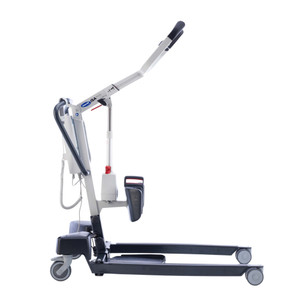
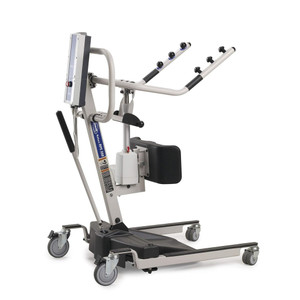
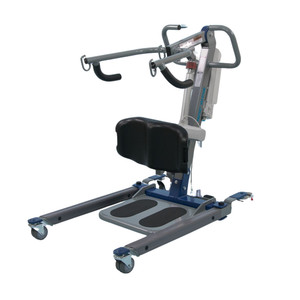
More about Sit-to-Stand Lifts
Sit-to-stand lifts provide transfer support for people who retain some ability to bear weight but need assistance rising from a seated position. The models in this category include battery-powered and hydraulic stand-up lifts, with standard, compact, and higher-capacity configurations for moving between a bed, wheelchair, commode, or other seated surface.
Our selection includes stand-assist equipment from manufacturers such as Invacare and Proactive Medical. Options range from compact powered models for tighter rooms to lifts with capacities of up to 600 pounds. If the person cannot participate in the transfer or bear weight through at least one leg, explore our broader selection of patient lifts to compare full-body transfer solutions.
Benefits of a sit-to-stand transfer lift
A sit-to-stand lift supports the natural motion of rising rather than suspending the entire body in a sling. A compatible stand-assist sling supports the torso while the lift raises the user into a supported standing position. Knee pads and a foot platform provide additional stability during the transfer. This design can help a person use their remaining strength while giving the caregiver mechanical assistance with the most demanding part of the movement.
These lifts are particularly useful for repeated, short transfers throughout the day. They can make it easier to move from a wheelchair to a toilet, from a bed to a chair, or between two nearby seated surfaces. Because the user is brought into a supported upright position, a stand-up lift can also make clothing adjustment and personal care more manageable when the individual has the physical ability to use this type of equipment.
Sit-to-stand or full-body, then powered or hydraulic
The first decision is whether a sit-to-stand lift matches the user’s functional ability. This type of lift is generally designed for someone who can bear some weight through at least one leg, maintain enough upper-body control for the selected sling, follow directions, and participate in the transfer. A full-body lift is usually the more appropriate category when the person cannot bear weight, has very limited trunk or head control, cannot cooperate with the transfer, or must remain fully supported from beneath the body.
Once sit-to-stand has been identified as the appropriate lift type, compare hydraulic and battery-powered operation. A hydraulic model is raised through manual pump strokes and lowered with a controlled release mechanism. A powered model uses an electric actuator, typically operated from a hand control, which can reduce the physical effort required from the caregiver. Compact powered lifts offer another option when storage space, narrow paths, or maneuvering near furniture are major concerns, although dimensions and base clearance still need to be checked carefully.
How to choose
Begin with the user’s current abilities, not simply a diagnosis or body weight. The individual should be assessed for weight-bearing ability, trunk control, cooperation, and tolerance for the supported standing position. Needs can change over time, so input from a qualified healthcare professional can help determine whether a stand-assist lift remains appropriate.
Next, look at the rooms and surfaces involved in daily transfers. Measure doorways, floor space, bed clearance, wheelchair access, and the area around the toilet or commode. A lift that appears compact on paper still needs enough room for its legs to open, approach the seating surface, and turn with the caregiver in position.
- User participation: Confirm that the person can bear some weight, remain sufficiently upright, and follow instructions during the transfer.
- Lift capacity: Select a model whose rated capacity exceeds the user’s current weight while also considering changes that may reasonably occur. Available products in this category span several capacity levels.
- Powered or hydraulic operation: Powered lifts can reduce repetitive pumping, while hydraulic lifts offer straightforward manual operation without relying on a charged battery for lifting.
- Overall dimensions: Compare the lift’s width, length, turning space, and base-leg range with the actual transfer environment.
- Under-bed and furniture clearance: Check whether the base can fit beneath or around the bed, chair, commode, or wheelchair used for transfers.
- Compact design: A compact sit-to-stand lift can help in smaller rooms, but verify that reduced dimensions do not conflict with the user’s size, required sling, or transfer setup.
- Sling compatibility: Use a stand-assist sling approved for the chosen lift. Check its size, attachment style, support level, and laundering instructions before ordering.
- Knee and foot support: Review the position and adjustability of the knee pad and foot platform. Proper contact helps support the user during the rising motion.
- Caregiver workflow: Consider how often the lift will be used, who will operate it, and whether the caregiver can comfortably maneuver and control the selected model.
- Battery and controls: For an electric lift, review charging requirements, battery indicators, emergency lowering provisions, and the availability of replacement batteries or controls.
The lift, sling, user, caregiver, and room all work as one transfer system. A suitable weight rating alone does not establish that every part of that system is compatible. Review the manufacturer’s instructions and product specifications, and contact Aracent Healthcare if you need help comparing dimensions, operating methods, or accessory requirements.
Frequently asked questions
Choosing transfer equipment often comes down to a few practical questions: how much the user can participate, how much room is available, and how frequently transfers occur. The answers below address the differences that matter most when comparing sit-to-stand lifts.
Individual models vary in capacity, dimensions, sling requirements, and controls. Always review the specifications for the exact lift being considered rather than assuming that a feature shown on one product applies to the entire category.
What is the difference between a sit-to-stand lift and a full-body patient lift?
A sit-to-stand lift supports a person while moving from sitting into a partially or fully upright supported position. It is intended for users who retain some weight-bearing ability and can participate in the transfer. Support is generally provided around the torso, with the feet placed on a platform and the knees positioned against padded supports.
A full-body patient lift supports the user from beneath the body in a larger sling. It is generally considered when the person cannot bear weight or cannot maintain the control needed for a standing transfer. The choice should be based on present functional ability and the transfer plan established by the user’s healthcare team.
How much weight-bearing ability is needed for a stand-up lift?
The user generally needs to bear some weight through at least one leg and tolerate the movement from sitting toward standing. The person should also have enough trunk and head control for the selected equipment, unless the specific lift and sling configuration is designed to provide the additional support required.
There is no single percentage of body weight that applies to every person or lift. Strength, balance, cognition, joint range of motion, pain, skin condition, and the ability to follow directions can all affect suitability. A physical therapist, occupational therapist, or other qualified professional can assess these factors before the lift is used.
Should I choose a powered or hydraulic sit-to-stand lift?
Powered models raise and lower the user through an electric actuator controlled by buttons or a hand pendant. This can be useful when transfers are frequent or when manual pumping would be difficult for the caregiver. Battery charging becomes part of the routine, and the operator should understand the model’s emergency lowering procedure.
Hydraulic lifts use a manual pump to raise the user and a release control to lower them. They do not depend on battery power for the lifting motion, but each transfer requires physical pumping by the caregiver. Consider transfer frequency, caregiver strength, charging access, maintenance preferences, and the pace at which the equipment will be used.
When does a compact sit-to-stand lift make sense?
A compact model can help when transfers take place in a bedroom crowded by furniture, a smaller bathroom, or a home with narrow travel paths. Its shorter or narrower footprint may also make storage more convenient. Products such as compact electric stand-up lifts are designed with these settings in mind.
“Compact” does not mean that a lift will fit every room or under every piece of furniture. Compare the complete dimensions, base-leg opening range, turning requirements, and under-bed clearance with measurements taken in the home. There must also be room for the caregiver to approach, attach the sling, and operate the lift without awkward positioning.
How do I choose the correct weight capacity?
Check the lift’s stated safe working load or maximum user weight in the manufacturer’s specifications. Choose equipment with a rating that accommodates the user without exceeding the limit. The current selection includes standard-capacity and higher-capacity stand-assist lifts, so buyers can compare appropriate frame sizes and operating configurations.
Capacity should not be considered by itself. A higher-rated lift may have a wider or longer base, and the sling must have an appropriate rating and fit as well. User dimensions, knee-pad positioning, foot placement, seat access, and room clearance remain important even when the lift’s weight rating is sufficient.
Is a sling included with a sit-to-stand lift?
Inclusion varies by product. Some lifts may be sold with a sling, while others require one to be selected separately. Product listings should be checked closely for package contents, since photos may show accessories that are not included with the lift.
The sling must be compatible with the lift’s attachment system and appropriately sized for the user. Sling style also affects the level of torso, waist, or underarm support provided. Do not substitute a full-body sling or an unapproved attachment simply because it fits the lift hooks. Follow the lift and sling manufacturers’ compatibility and use instructions.
Can a sit-to-stand lift be used by one caregiver?
Some models and transfer plans may allow operation by one trained caregiver, but this should not be assumed for every user or setting. The person’s participation, balance, behavior, medical needs, and the complexity of the room can affect how many caregivers are required. Facility policies and the user’s professional transfer assessment should also be followed.
Before routine use, caregivers should understand sling placement, base positioning, knee-pad adjustment, controls, emergency functions, and the correct sequence for approaching each surface. If you are ready to compare hydraulic, powered, or compact sit-to-stand lifts, review the products above or contact Aracent Healthcare for personalized assistance selecting equipment that fits the user and transfer environment.