Full Body Patient Lift Slings for Supportive Transfers
Full body slings are designed for users who need substantial support throughout the transfer process. Compared with more open sling styles, they provide broader coverage around the back, trunk, pelvis, and legs and are commonly used for individuals with limited mobility, reduced trunk control, or limited ability to assist with transfers.
The correct sling depends on the user, the type of transfer being performed, and the patient lift being used. Sling size, material, weight capacity, attachment style, and toileting needs should all be considered before ordering.
Full Body and Head Support
Full body slings provide support over a large portion of the user's body and typically extend upward to support the head and neck.
This makes them especially useful for individuals who require a high level of support during transfers or who have limited head, neck, or trunk control.
The amount and type of support can vary by sling design, so always review the intended-use information for the specific model being considered.
Mesh vs. Solid Fabric Slings
Full body slings are available in both mesh and solid fabric constructions.
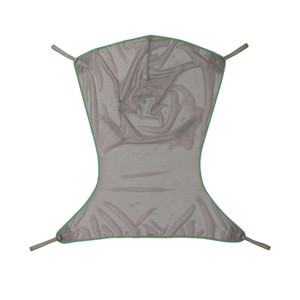
Mesh slings allow water to drain through the material and generally dry more readily, making them well suited to bathing, showering, and other wet environments.
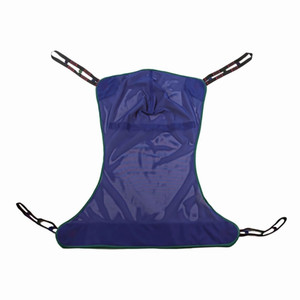
Solid fabric slings provide an alternative for routine dry transfers and everyday use.
Material construction, padding, care requirements, and intended applications vary between sling models, so compare the specifications for the exact sling before selecting one.
With or Without a Commode Opening
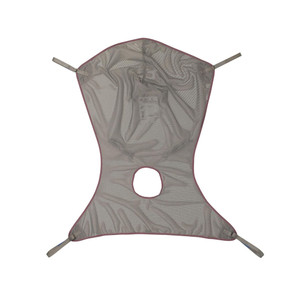
Some full body slings include a commode opening, while others use a continuous support surface.
A commode-opening sling provides access for toileting and hygiene while the user remains supported by the sling. This can be useful when transfers involve a toilet or commode.
A solid-seat sling does not include this opening and provides a continuous support surface beneath the user.
The appropriate style depends on the type of transfers being performed and the user's care needs.
How to Choose a Full Body Sling
Choose the Correct Sling Size
Sling sizing should be based on the manufacturer's sizing guidance for the individual user rather than the wheelchair or lift alone.
A sling that is too large or too small may not position or support the user as intended. Use the manufacturer's measurements and sizing chart for the specific sling model whenever available.
Do not select sling size based only on weight capacity.
Verify the Weight Capacity
After determining the appropriate sling size, separately confirm that the sling's rated weight capacity is appropriate for the user.
Different sling models and sizes may have different weight limits. Always use the capacity listed for the exact product being ordered and never exceed the manufacturer's rated limit.
Decide Between Mesh and Solid Fabric
Consider how and where the sling will be used.
Mesh is typically preferable for bathing or other wet environments because it allows drainage and dries more readily. Solid materials may be appropriate for routine dry transfers.
Cleaning requirements and care instructions should also be considered, particularly in healthcare facilities or other environments where slings require frequent laundering.
Decide Whether Toileting Access Is Needed
If the sling will regularly be used for toileting transfers, a model with a commode opening may provide more convenient access for hygiene and clothing management.
If toileting access is not required, a sling without an opening may be more appropriate.
Confirm Lift and Sling Compatibility
Patient lift slings should not be assumed to be universally interchangeable.
Compatibility depends on the sling design, attachment style, lift, spreader bar, and manufacturer's requirements. Confirm that the sling is approved or appropriate for the patient lift being used before ordering.
Do not rely only on the fact that both products are described as patient lifts or patient lift slings.
Check the Attachment Style
Full body slings commonly attach to the lift using loops or other model-specific attachment systems.
The sling's attachment points must be appropriate for the lift's spreader bar or hanger. Review both the sling and lift documentation before use.
Full Body Slings vs. Other Patient Lift Slings
Different sling styles are designed for different transfer and positioning needs.
A full body sling provides broad support and is generally appropriate when the user requires substantial trunk, head, and lower-body support throughout the transfer.
A divided leg sling uses separate leg sections and may provide greater flexibility for certain seated transfers and positioning needs.
A toileting sling is typically more open around the lower body to provide easier clothing and hygiene access, but generally requires the user to have sufficient trunk and head control for that style of sling.
When choosing between sling types, consider the user's level of support, transfer method, toileting requirements, and compatibility with the patient lift.
Frequently Asked Questions
What is a full body sling?
A full body sling is a patient lift sling that provides extensive support around the user's back, trunk, pelvis, and legs during a transfer.
Most full body designs also extend high enough to support the head and neck, making them suitable for users who require a high level of physical support while being transferred.
Who should use a full body sling?
Full body slings may be appropriate for individuals who require substantial assistance during transfers, including users with limited mobility, reduced trunk control, limited head control, or limited ability to participate in the transfer.
The specific sling should be selected according to the individual's mobility, positioning, size, and care needs.
What is the difference between a full body sling and a divided leg sling?
A full body sling provides broad support around the trunk and lower body and typically includes substantial head and neck support.
A divided leg sling has separate leg sections and can offer greater flexibility in positioning the legs during certain transfers.
The appropriate style depends on the user's physical support needs and the types of transfers being performed.
What is the difference between mesh and solid full body slings?
Mesh slings allow water to pass through the fabric and dry more readily, making them particularly useful for bathing and showering.
Solid fabric slings provide an alternative for routine dry transfers.
Other features, such as padding, material thickness, and care requirements, vary by product.
Should I choose a full body sling with a commode opening?
A commode opening can be useful when the sling will be used during toileting because it provides access beneath the user while the sling remains in place.
If toileting access is not required, a sling with a continuous support surface may be appropriate instead.
How do I choose the correct sling size?
Follow the sizing chart or measurement guidance provided for the specific sling.
Sling size should be matched to the user's body measurements and should not be selected based solely on wheelchair size or weight capacity.
If you are unsure between sizes, verify the user's measurements before ordering.
Can I use any full body sling with my patient lift?
No. Sling compatibility depends on the lift, spreader bar or hanger, attachment style, and manufacturer's requirements.
Always confirm that the sling is compatible with the specific patient lift before use.
Are full body slings washable?
Many full body slings are designed to be laundered, but washing instructions vary according to the fabric and manufacturer.
Follow the care instructions supplied with the specific sling, including any requirements for water temperature, drying, or inspection after cleaning.
Find the Right Full Body Sling
When selecting a full body sling, start with the user's support needs and the type of transfers being performed. Then confirm the correct size, weight capacity, material, commode-opening preference, attachment style, and compatibility with the patient lift.
If you are unsure which sling is appropriate for a specific lift or user, contact Aracent Healthcare with the patient lift model, sling attachment type, user measurements, and the type of transfer being performed so we can help narrow the available options.